Part 6: Amodei, Anthropic & the Lesson of Paul Atreides
Part 6 of an ongoing series on Modern AI History.
If you've read Frank Herbert's books or watched the first two of the excellent Villeneuve films, you'll be familiar with Dune's anti-hero, Paul Atreides. Through Atreides, Herbert tells a cautionary tale of good men who are capable of catastrophic things when they're convinced they are the only ones who can see things clearly.
A rightful prince, suffering betrayal, Atreides finds refuge among the Fremen and discovers he can see the future more clearly than anyone around him — including the holy war his own rise will trigger, a jihad that will kill billions across the galaxy. He sees it early, sees it often, and keeps walking toward the throne anyway, convinced that only he has the vision to steer the catastrophe into its least terrible shape. The gift that made him great is the thing that made him ruinous. The man who saw furthest became the man who couldn't stop.
There is no shortage of people in modern AI who believe they can see the trouble on the horizon more clearly than everyone else, but it is Anthropic's CEO, Dario Amodei, who possesses the two most powerful frontier models at the time of writing — Claude Opus 4.7 and the notorious Claude Mythos. Like Dune's protagonist, Amodei runs the risk of ushering in the very future Anthropic was built to prevent. Perhaps nothing demonstrates that more clearly than recent events.
Early 2026
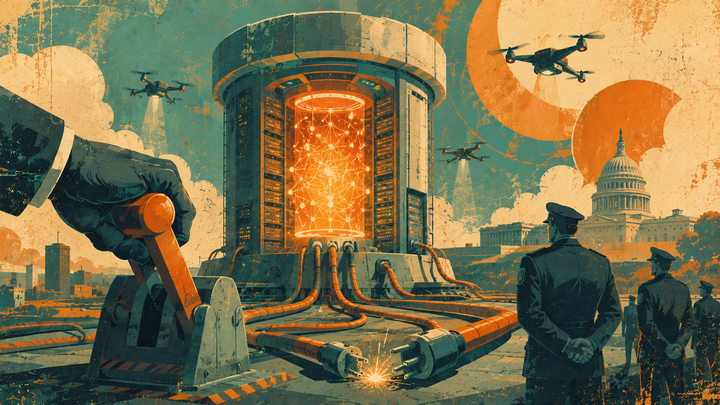
In late February this year, Anthropic was finalising a Pentagon deal that would make Claude Gov — already the only AI running in the Pentagon's classified cloud — an official tool of the Department of Defense. Amodei asked for two contractual provisions restricting the government from using Claude to undermine democracy, citing things like the warrantless purchase of Americans' movement and browsing data. He made clear he'd walk from the deal if the terms weren't met. The Pentagon's lead negotiator, Emil Michael, publicly called him "a liar with a god complex." The public sided with Anthropic. ChatGPT uninstalls jumped 295% in a day, a QuitGPT campaign drew 1.5 million signatures, and Claude hit number one on the App Store.
A month later, he was on every podcast talking about how AI would hollow out white-collar work. It landed the same week a poll found AI less popular than ICE — and whatever you think of the methodology, it's hard to argue Amodei's public persona has done the technology any favours. He's a difficult man to place. But maybe his story gives us more clues.
Picking up where we left off
We last saw Dario at the Rosewood in late 2015 — the thirty-two-year-old Princeton physicist Musk tried to recruit, who listened politely and went to Google Brain instead. He lasted less than a year there before changing his mind. In July 2016 he phoned OpenAI, asked if the offer still stood, and joined as a research scientist. By 2018 he was running the research team. By 2019 he was VP of Research, and the man most responsible for GPT-2, GPT-3, and the technique — reinforcement learning from human feedback — that turned next-word prediction into something you could have a conversation with. Four years in, he was arguably the most important researcher in the building.
In December 2020, Dario walked. Daniela — his younger sister, who'd been running policy and partnerships at OpenAI after starting her career at Stripe — walked with him. So did Jack Clark, Tom Brown, Chris Olah, Sam McCandlish, and two others. Seven senior people, most of them central to the GPT-3 work. It remains the largest talent exodus in OpenAI's history, and it took with it a large chunk of the researchers who knew how the company's best model actually worked.
They founded Anthropic the following year. Dario took CEO, Daniela took President. They incorporated as a Public Benefit Corporation — a structure that legally binds directors to weigh public good alongside profit — and made the pitch explicit: frontier AI, built the careful way. The way OpenAI was supposed to — building models at the edge of what's possible, while taking the safety risks seriously enough to slow down, test, and sometimes not ship at all.
The money came quickly. A $124 million Series A led by Jaan Tallinn, the Skype co-founder who'd since turned most of his attention to existential risk. By the end of 2022, another $700 million on top, including $300 million from Google and $500 million from a crypto exchange called FTX, run by a young man named Sam Bankman-Fried. The FTX money would become complicated a few months later for reasons that had nothing to do with Anthropic.
The birth of Claude
By the summer of 2022, Anthropic had trained its first frontier model. They called it Claude, after Claude Shannon — the mathematician who proved in 1948 that English had statistical structure, that you could predict the next letter in a sentence if you understood the pattern. Every language model built since is an industrial-scale version of that insight. Naming the AI Claude was a lineage claim. Not a chatbot. The continuation of a seventy-year-old mathematical tradition.

By internal benchmarks, Claude was competitive with what OpenAI had. Anthropic chose not to release it. The reason was the thing they'd founded the company on — shipping Claude would kick off the race they'd left OpenAI to avoid. Better to hold it in-house, keep testing, keep building the safety work, and not be the ones who fired the starting gun.
They wouldn't have to wait long for someone else to do it.
→ Next: The day Prometheus gave us ChatGPT
← Previous: Attention is all you need
Read the full series: Modern AI History