Part 4: Open's Eleven
Part 4 of an ongoing series on Modern AI History.
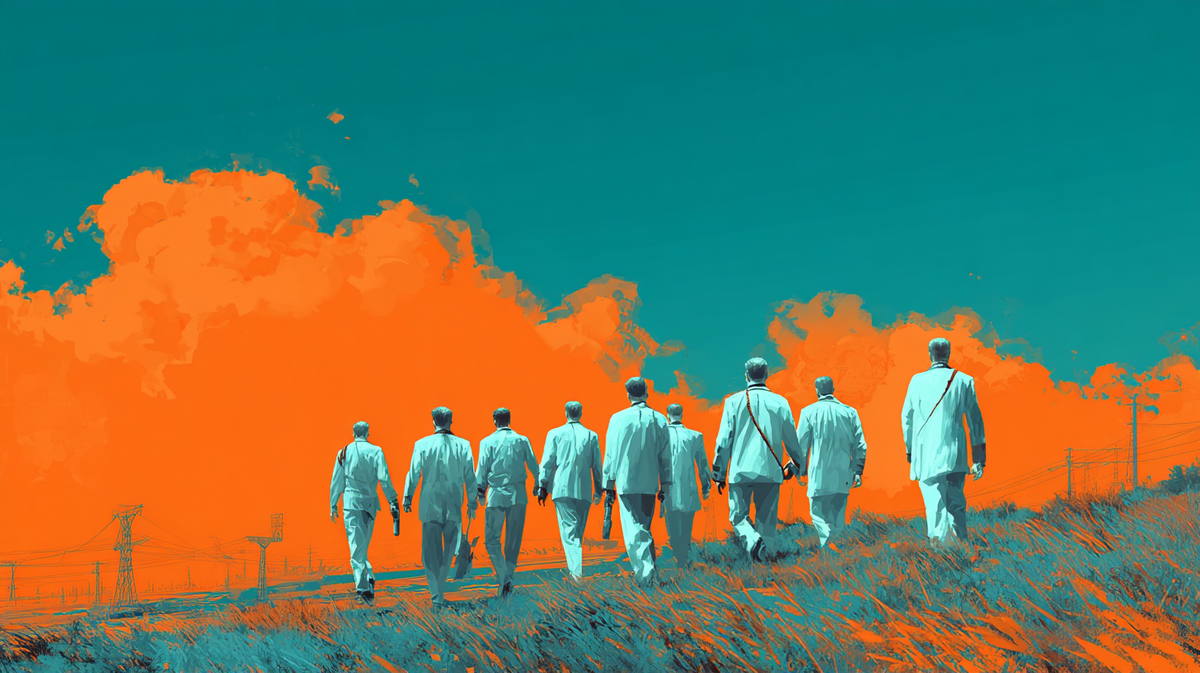
All great heist movies have an iconic dining scene. The most famous, Heat, has De Niro and Pacino making a gentleman's agreement to jostle to their ends. Our story ends similarly, perhaps a little less gentlemanly, but starts in a very different place.
Musk, fresh off his birthday argument, orchestrates the setup with a thirty-year-old who had quietly become one of the most connected men in Silicon Valley. His name was Sam Altman, the baby-faced general of Y Combinator, a startup accelerator that helped launch Airbnb, Dropbox, and Stripe. Musk brought the money and the grievance. Altman brought a Rolodex of his own and the sales skills to use it.
Their mutual distrust of Google, and the confidence against all odds to build an opposition, leads us to our dining scene. Musk and Altman rounded up every great mind they could find and sat them down at the Rosewood Sand Hill — sixteen acres at the foot of the Santa Cruz Mountains in Menlo Park, just off the street where Silicon Valley's biggest venture capital firms keep their offices. It's the kind of hotel where billion-dollar deals get made over a Michelin-starred lunch and nobody at the next table blinks. OpenAI started as a heist on Google dominance, and this was the perfect place for its birth.
The Crew
Altman brought Greg Brockman, who he knew through Y Combinator — Brockman had been the CTO of Stripe, one of YC's biggest success stories, and had dropped out of both Harvard and MIT along the way. Brockman wasn't an AI researcher. He was a builder, the kind of person who could take a roomful of brilliant people and turn them into something that actually worked. After the dinner, it was Brockman who spent the next four months doing the unglamorous legwork of actually assembling the founding team — cold-calling researchers, chaining through referrals, convincing sceptics. He's still at OpenAI today, as President.
Then there was Ilya Sutskever. If you've been paying attention, you've met him already — the quiet Russian-Israeli from the Toronto bedroom who helped build AlexNet alongside Geoffrey Hinton. After the $44 million Google acquisition, Ilya had become one of the most respected AI researchers on the planet. He was also the hardest person to recruit. Musk went after him personally. The pitch wasn't money — Google could beat anything they offered. The pitch was the mission. Ilya said yes to a path that would eventually crown him OpenAI's Chief Scientist, the intellectual engine of the entire operation. Eight years later, he would try to burn it down from the inside.
John Schulman had just finished his PhD at Berkeley, where he'd been obsessed with reinforcement learning — the same approach DeepMind was using to teach machines to play Atari. He joined OpenAI before he'd even formally graduated. It turned out to be a good call. Schulman would go on to lead the team that built ChatGPT — the product that, seven years later, would make OpenAI a household name. He has since been referred to as its architect. He's no longer there.
Wojciech Zaremba was a twenty-six-year-old Polish mathematician who had won a silver medal at the International Mathematical Olympiad at nineteen and built a lab in his parents' cellar at sixteen. He turned down what he later called "borderline crazy" offers from Facebook and Google to be there. At OpenAI, he would lead the robotics team, build a robotic hand that could solve a Rubik's Cube, and later help develop the code behind GitHub Copilot. Of the eleven people who went on to found OpenAI, he is one of only three still at the company today.
The rest of the founding eleven — Trevor Blackwell, Vicki Cheung, Durk Kingma, Pamela Vagata, and Andrej Karpathy — weren't at the Rosewood dinner. They were recruited in the months that followed, mostly by Brockman, who worked the phones through the autumn of 2015 chaining through referrals and convincing sceptics one by one. By December, the crew was assembled.
The pitch that made it possible was the structure. OpenAI wouldn't be a startup. It would be a non-profit — no shareholders, no IPO, no pressure to race. Whatever it built would be released openly, for the benefit of humanity rather than the benefit of a single company. That was the whole point, and it was in the name. Musk and a handful of allies — Peter Thiel, Reid Hoffman, and AWS, among others — pledged a combined one billion dollars to get it off the ground. In practice only a fraction of that was ever called upon, but the headline figure did the work: it told every researcher worth recruiting that this wasn't a side project. It was an institution, built to outlast its founders.
On December 11th, 2015, OpenAI was announced to the world.
The Ambivalent
Not everyone Musk wanted at the table said yes. There was a thirty-two-year-old physicist Musk had personally tried to pull in — a Princeton biophysics PhD who had spent the past year at Baidu's Silicon Valley lab working with Andrew Ng on speech recognition, a project that would quietly plant in him the observation that later became the most important idea in modern AI: make the model bigger, feed it more, and it just keeps getting better. Musk wanted him at the Rosewood. He came, he listened, and he passed. The fledgling organisation didn't quite convince him, and he went to Google Brain instead. His name was Dario Amodei. He'd come back around eventually — just not to stay.
→ Next: Attention is all you need
← Previous: The Maverick Magicians who Turned a Page
Read the full series: Modern AI History