Part 3: The Maverick Magicians Who Turned a Page
Part 3 of an ongoing series on Modern AI History.
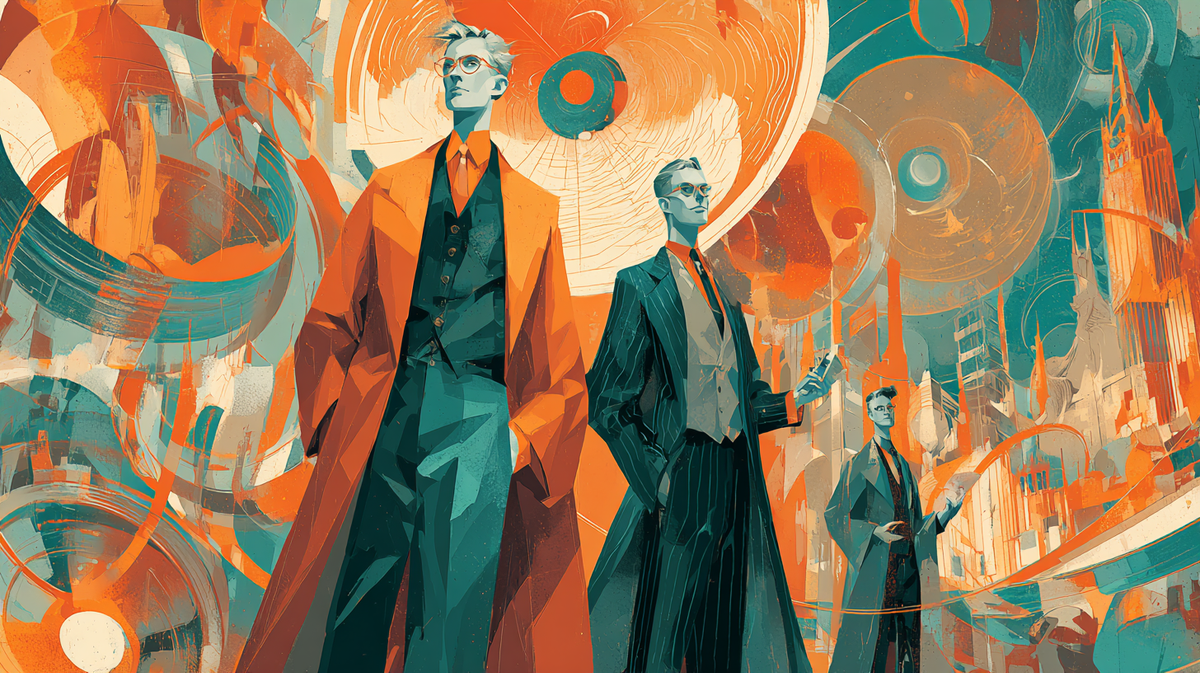
We didn't plan it this way, but our next story is also about a trio. Maybe there's something in threes.
A five-minute walk from the brick column at King's Cross station where Harry Potter pushes his trolley through the wall to Platform 9¾, you'll find a glass office building on Handyside Street. It belongs to a company called DeepMind. And like the platform around the corner, the people inside it have always believed they were headed somewhere most of the world couldn't see.

If you'll allow me to push the similarities one notch further, DeepMind's frontman, Demis Hassabis, bookish and bespectacled, sizzles with the same scent of destiny as Rowling's protagonist. A chess prodigy by five, an international master a few years later, briefly the second-best player in the world for his age — and then he walked away from the game to solve bigger problems. At thirteen. He bought his first computer with chess winnings. Read computer science at Cambridge by sixteen. Wrote his first commercial video game at seventeen. Built a hit game studio in his twenties.
Then he walked away from gaming too, to do a PhD in cognitive neuroscience. Not because he wanted to be a neuroscientist, but because he wanted to understand the brain well enough to build one. During his studies he met Shane Legg, a New Zealand–born theoretician who had written a mathematical theory of machine intelligence for his PhD. The third member arrived through an unlikely route: Mustafa Suleyman, a twenty-six-year-old Oxford dropout whose best friend happened to be Demis's younger brother. Mustafa had no technical background. What he had was a decade of social activism and policy work — exactly the operator they needed to actually build a company.

Hassabis had finally found the problem he'd spent his whole life circling. And DeepMind was audacious enough, on day one, to say it out loud: solve intelligence, then use it to solve everything else.
The Road to AGI
That phrase needs a quick translation. They were talking about AGI — artificial general intelligence. Not a system that could recognise cats or play chess, but one that could do everything a human can, and probably more. When DeepMind put it on their founding documents in 2010, most serious researchers refused to use the term, partly out of embarrassment (AGI had been promised since the 1950s and never delivered) and partly because it's the version of AI that makes people uncomfortable.
Once you build a machine that can do everything a human can, you've built something with consequences nobody is ready for. Whose values does it have? Who controls it? What happens to every job and institution that depends on humans being the only general intelligence on the planet? Respectable researchers preferred to leave those questions to philosophers and science fiction writers.
DeepMind's first step on its path to AGI was through reinforcement learning — you drop a machine into an environment with a goal and let it learn by trial and error. Reward when it gets closer, punish when it doesn't, repeat a million times. Where Hinton's camp was teaching machines to recognise the world, DeepMind was teaching them to act in it.
That approach translated naturally to games. Games have clear goals, clear rules, and a score. So for three years, DeepMind taught machines to play Atari. Breakout, Pong, Space Invaders. By 2013, they had a system that could be handed any of those games and beat human players within hours. In the Breakout demo, it figured out on its own that the best strategy was to tunnel a hole through the wall and let the ball bounce behind it. Nobody taught it that.
Reinforcement learning needed massive compute to scale, but as we saw with Hinton and co in 2012, that was becoming far more realistic. The big players came swirling. Two years after acquiring DNNresearch, Google won another bidding war — beating out Facebook and a handful of others — and bought DeepMind for around $500 million.
The Blue Birthday
Our story's version of a Red Wedding is far less bloody, but no less consequential. By mid-2015, Google had the data, the talent, and now DeepMind — the most ambitious AI lab in the world. The most powerful technology in human history was being built inside a single company, run by Larry Page, a man who increasingly concerned his close friend, a pre-X Elon Musk.

In July 2015, at Musk's forty-fourth birthday party in Napa Valley, they finally had it out. Musk warned that AI without safeguards could make humanity irrelevant. Page dismissed the concern as "sentimental nonsense" and called Musk a "speciesist" — someone who unfairly favoured his own kind.
It was an argument that ended a decade-long friendship. And more importantly, started the AI race.
→ Next: Open's Eleven
← Previous: The Godfather's 40-Year Bet
Read the full series: Modern AI History